The Directed Human-Like Being on One Earth
Ancient Fossils, Material Ancestry, and the 12,000-Year Divide
Read the original publication and reproduction archive ↗1. The Scientific Question
Can anatomical resemblance, shared terrestrial history, material genealogy, and individual identity be treated as the same physical relation?
Why does the geological record preserve hundreds of thousands of years of human-like occupation and creative activity, while the much shorter recent interval contains the emergence of increasingly integrated scientific, industrial, and spacefaring civilization?
Paper XXXII develops a geological, mathematical, and chronological investigation of these questions within Six-Throat Directed Geometry.
2. The One-Earth Geological Record
The investigation retains the published chronological measurements, anatomical classifications, and archaeological associations of the ancient material record.
| Archaeological anchor | Reported age | Documented evidence |
|---|---|---|
| Jebel Irhoud | 315 ± 34 ka | Early Homo sapiens fossils and associated heated flints |
| Omo I | 233 ± 22 ka, minimum-age estimate | Fossil context constrained by volcanic stratigraphy |
| Blombos Cave | Approximately 73 ka | Intentional ochre drawing |
| Leang Karampuang | At least 51.2 ka | Figurative rock-art composition |
| White Sands | Approximately 21–23 ka | Human footprints |
| Göbekli Tepe | Approximately 9600–8200 BCE | Monumental stone architecture |
These records establish ancient physical presence, intentional production, technical capacity, and creative activity on the common Earth.
Geological age, anatomical classification, material genealogy, and individual identity remain distinct information registers.
3. The Civilizational Timescale Contrast
The central Jebel Irhoud age of 315,000 years and the selected 12,000-year comparative horizon define two historical windows.
Equation (1) — Civilizational Timescale Contrast
| Chronological quantity | Reference value |
|---|---|
| Earlier comparison interval | 303,000 years |
| Recent comparison interval | 12,000 years |
| Earlier-to-recent interval ratio | 25.25 |
| Recent fraction of the complete comparison horizon | 3.80952381% |
The earlier archaeological record contains genuine technical innovation, symbolic production, and organized activity.
The recent window contains increasingly integrated systems of agriculture, urban organization, writing, scientific measurement, industrial production, electronic technology, and human spaceflight.
The human lunar landing on 20 July 1969 constitutes a documented technological endpoint of the recent window.
The comparison concerns realized material systems and their functional integration, rather than a numerical ranking of individual intelligence.
4. Material Genealogical Discontinuity
The Material Genealogical Discontinuity Hypothesis (MGDH) establishes the central theoretical proposition of Paper XXXII.
It assigns distinct material genealogical histories to the ancient pre-12,000-year population and present humanity.
Equation (11) — Material Genealogical Discontinuity Hypothesis
The genealogical connection variable Γ distinguishes two branches:
- Γ = 0: material genealogical discontinuity.
- Γ = 1: material genealogical continuity across the selected boundary.
The MGDH specifies Γ = 0.
The proposed genealogical distinction preserves the geological dates and published anatomical classifications of the ancient fossils.
5. Morphological–Geological Non-Invertibility
The observable archive contains dated ages, anatomical characteristics, archaeological localities, and measured trace classes.
Material descent is represented separately by a historical ancestry graph.
Equation (13) — Observable Archive Projection
Theorem 8.1 establishes that, when two admissible historical worlds possess identical morphological–geological archives but different genealogical connections, the defined archive observation map is non-injective with respect to ancestry.
No reconstruction function acting solely on that observation map can distinguish the two genealogical states.
The result establishes the mathematical distinction between observable anatomical equivalence and historical parentage relations under the stated admissibility conditions.
6. Quantitative Models of Technological Integration
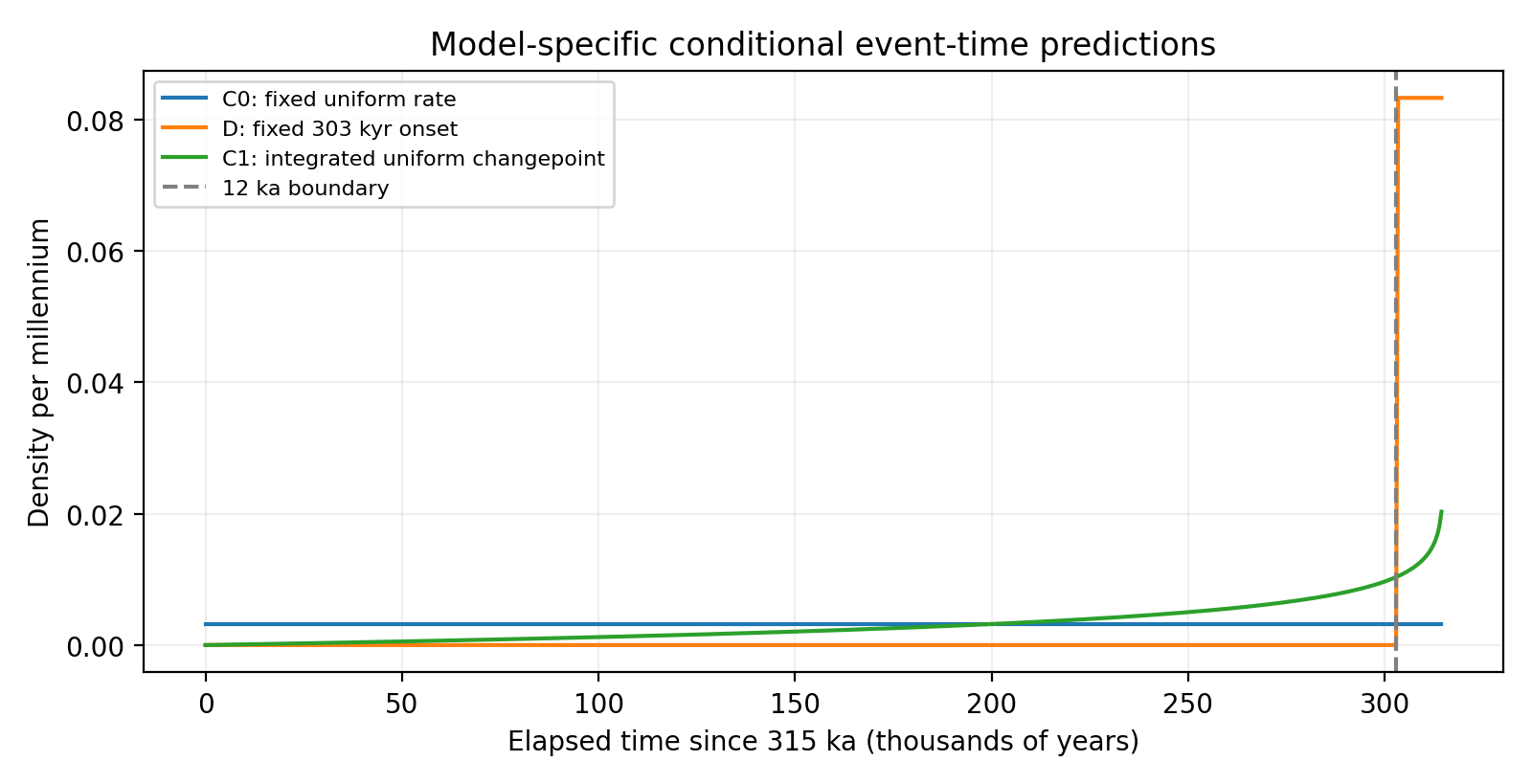
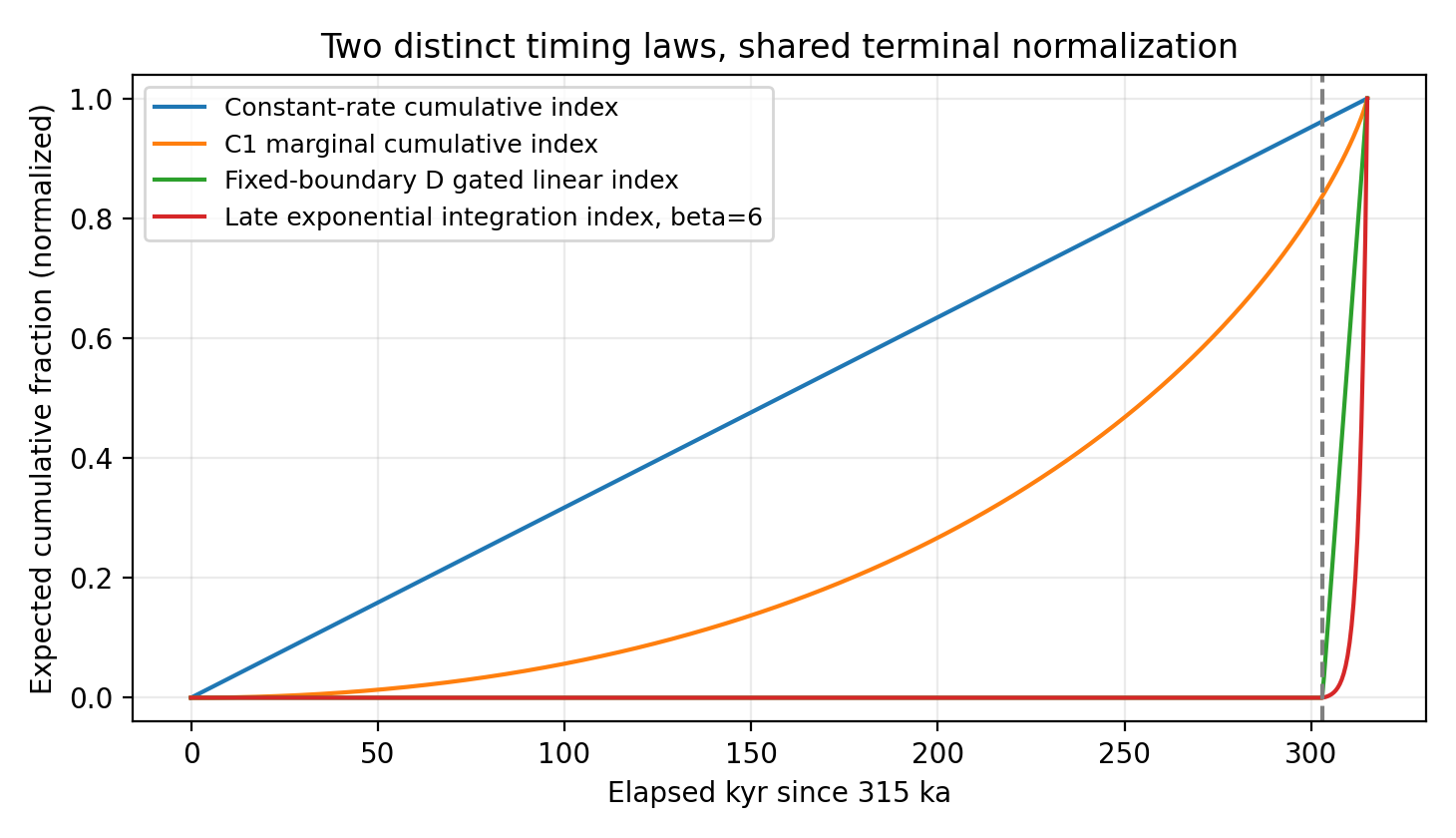
Three normalized event-time models are examined:
- C₀: constant event-time density across the complete historical horizon.
- D: fixed, independently specified late-window integration boundary.
- C₁: unknown-onset integration with a uniform changepoint prior.
The comparison is conditional on the total number of independent technical-integration events.
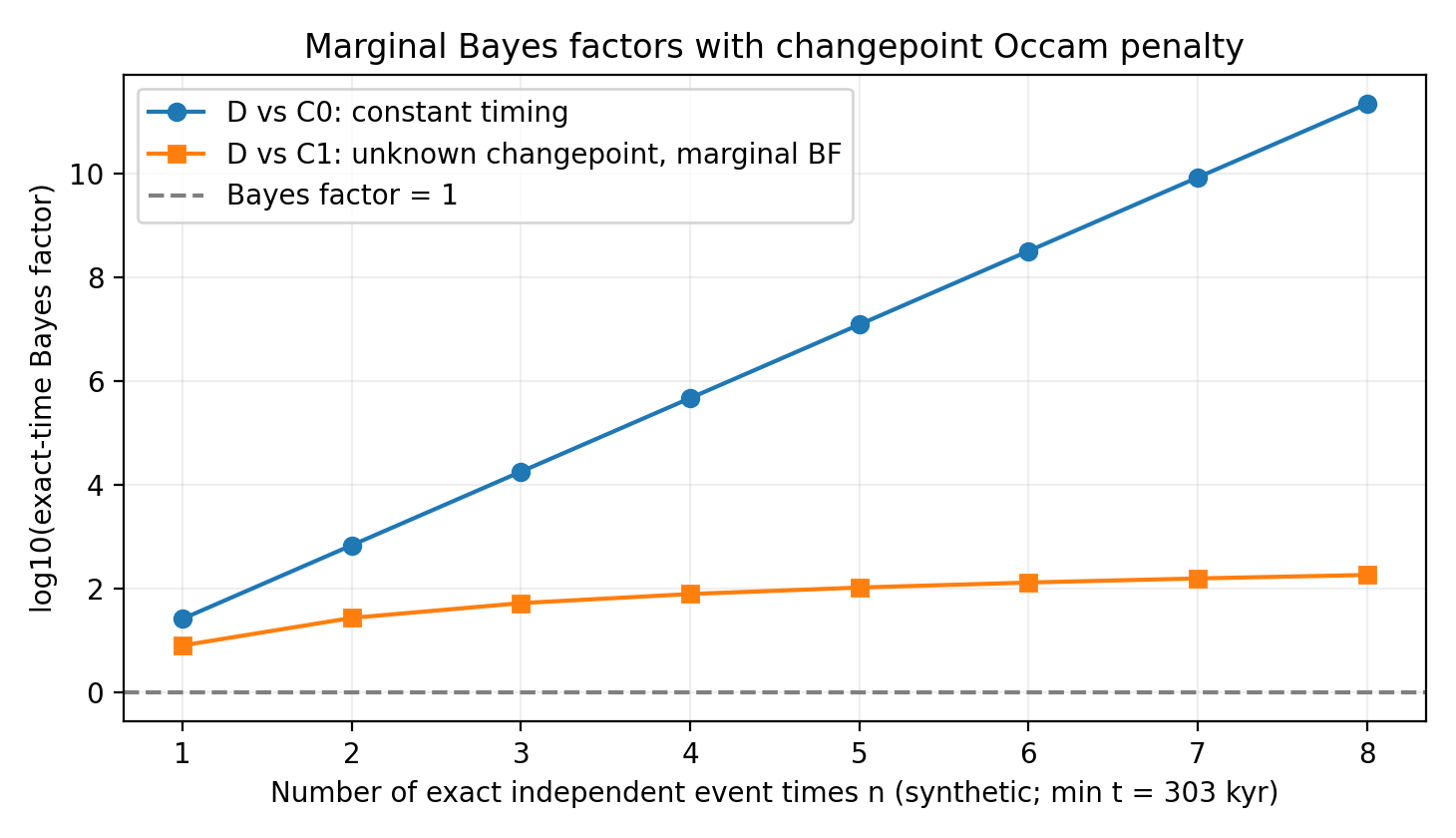
Theorem 9.1 derives the exact conditional Bayes factor for the fixed-boundary model relative to the constant-rate comparator.
Equation (20) — Conditional Bayes Factor
Theorem 9.2 integrates the unknown changepoint analytically, yielding the exact marginal comparison for event configurations whose earliest time coincides with the independently specified boundary.
Equation (22) — Marginal Changepoint Bayes Factor
| Synthetic independent-event count | D/C₀ Bayes factor | D/C₁ marginal Bayes factor |
|---|---|---|
| 1 | 26.25 | 8.033257 |
| 2 | 689.0625 | 27.289604 |
| 3 | 18,087.89 | 52.576301 |
| 5 | 12,463,690 | 105.000221 |
The numerical comparisons characterize explicitly defined timing models. The event counts are synthetic reference scenarios rather than an observed archaeological event census.
The genealogical variable remains independently defined.
7. Archaeological Preservation and Geological Non-Detection
The archaeological recovery model distinguishes material production, physical survival, survey coverage, exposure, and recognition.
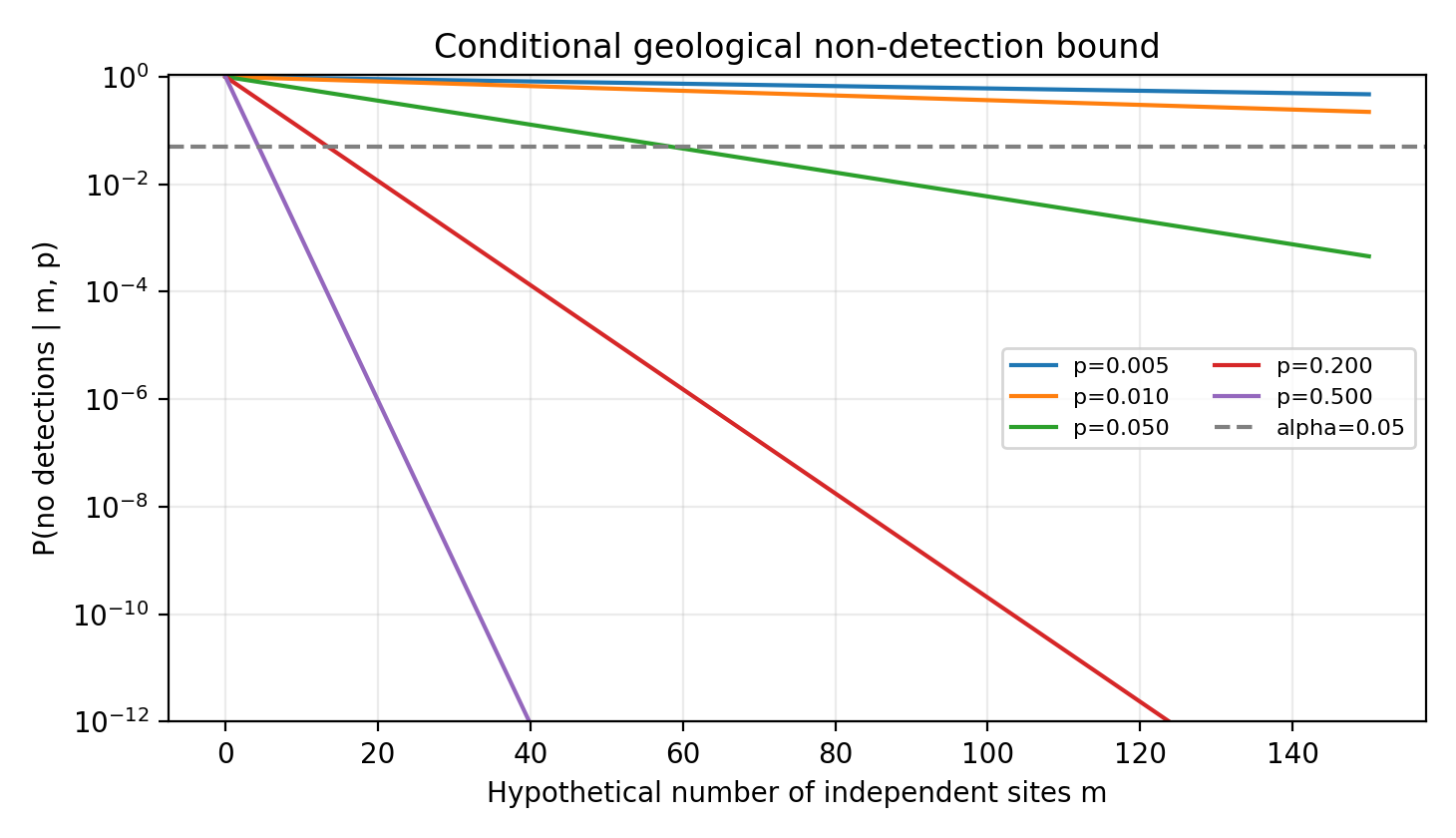
Theorem 10.1 derives a quantitative upper bound on the probability of zero archaeological detections under independent recovery and a specified minimum effective detection probability.
Equation (26) — Geological Non-Detection Bound
Under the independent-recovery assumptions of Theorem 10.1, with each effective detection probability at least p⋆.
Equation (27) — Critical Site Multiplicity
For a significance threshold of 0.05, the published numerical scenarios yield:
| Assumed effective detection probability | Minimum independent eligible sites |
|---|---|
| 0.005 | 598 |
| 0.010 | 299 |
| 0.050 | 59 |
| 0.200 | 14 |
| 0.500 | 5 |
| 0.800 | 2 |
The detection probabilities are model inputs.
The geological significance of non-detection depends jointly on material survival, search coverage, recognition probability, and the number of independently detectable sites.
8. Same-Face Succession and Contemporary Parallelism
The inherited directed geometry distinguishes two physical relations on one Earth.
The first is historical succession: the ancient human-like population associated with the older material record is assigned within the STDG construction to preceding cosmic cycles on the same directed face occupied by present humanity.
The second is simultaneous directional parallelism: the present independently aware counterpart occupies the opposite directed face of the common Earth.
The contemporary opposite-face counterpart and the ancient same-face occupants are distinct populations within the directed-history construction.
Neither shared locality nor anatomical resemblance determines individual identity, directed occupancy, or material genealogical continuity.
9. The Directed Cosmic-Day Chronology
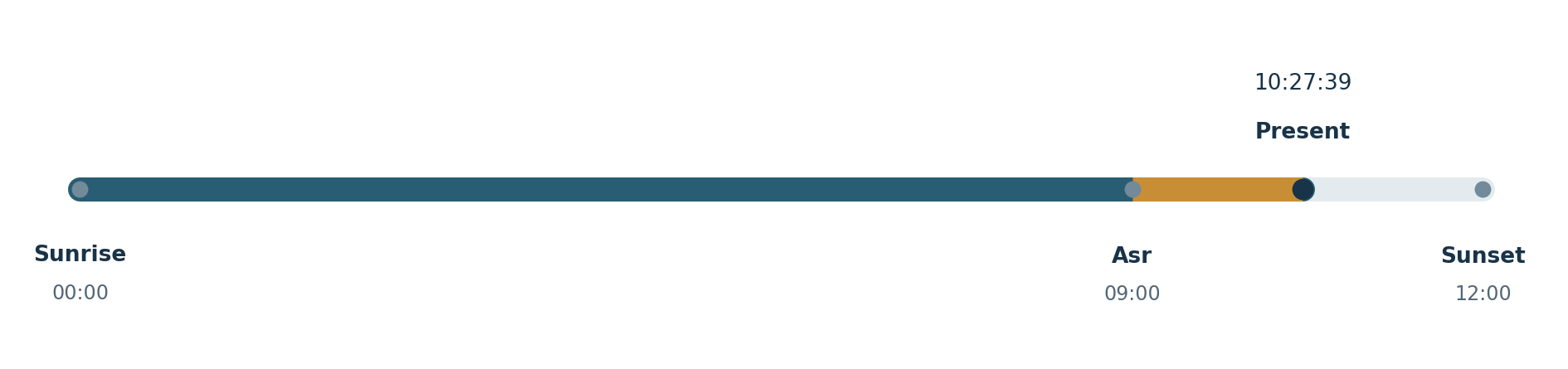
The inherited equinoctial correspondence defines twelve cosmic daylight hours, comprising 720 cosmic minutes.
The stipulated conversion is 16.67 terrestrial years per cosmic minute.
Equation (30) — Directed Cosmic-Day Duration
| Chronological quantity | Model value |
|---|---|
| One cosmic minute | 16.67 terrestrial years |
| One cosmic hour | 1,000.2 terrestrial years |
| Complete cosmic daylight interval | 12,002.4 terrestrial years |
| Present cosmic-hour coordinate | Approximately 10.4607 |
| Elapsed terrestrial duration | Approximately 10,462.8 years |
| Remaining terrestrial duration | Approximately 1,539.6 years |
| Inferred cosmic sunrise | Approximately 8440 BCE |
| Projected cosmic sunset | Approximately 3566 CE |
Equation (32) — Current-Cycle Chronology
The chronological calculation uses the manuscript’s 2026 CE reference.
The inferred current-cycle sunrise falls within the early Holocene, approximately 1.26 thousand years after the formal Pleistocene–Holocene boundary.
The 12,000-year archaeological reference horizon, the 12,002.4-year modeled daylight duration, and the inferred 10,462.8-year elapsed current-cycle duration are separately defined quantities.
10. Scientific Reproducibility
The accompanying computational package documents the mathematical models, numerical results, scientific figures, and reproducibility program.
The published computational protocol includes:
- Exact conditional event-time likelihoods.
- Analytical changepoint marginalization.
- Independent numerical quadrature.
- Coarse-window probability comparisons.
- Seeded Monte Carlo timing simulations.
- Geological non-detection bounds.
- Critical site-count calculations.
- Survival, coverage, and recognition sensitivity analysis.
The reference protocol specifies 50,000 seeded event-time simulations per example, using random seed 32017.
The numerical experiments examine the consequences of the stated model family and verify its mathematical implementation.
11. Invitation to Independent Scientific Examination
Researchers in geology, archaeology, paleontology, mathematics, statistical science, and physics are invited to examine the original dated records, formal definitions, analytical results, and numerical models.
Suggested examination points include:
- Chronological and stratigraphic classification of the ancient material record.
- Distinction between anatomical classification and material ancestry.
- The morphological–geological non-invertibility theorem.
- Exact conditional and marginal changepoint comparisons.
- Independent-thinning geological non-detection bounds.
- Distinction between historical succession and contemporary directional parallelism.
- The inherited cosmic-day chronological correspondence.
- Independently informative observations capable of discriminating between the two genealogical branches.
The prospective empirical program requires a measurable diagnostic whose predictive distributions distinguish Γ = 0 from Γ = 1 under the admissible nuisance-parameter models.
Equation (28) — Genealogically Discriminating Observation
Research Continuity
Paper XXVIII — The Blindness of Intensity: 10.5281/zenodo.23145251
Paper XXXI — Earth’s Unrecorded Past: 10.5281/zenodo.23451637
Full scientific publication and reproducibility archive — Paper XXXII: 10.5281/zenodo.23483405
Six-Throat Directed Geometry — STDG
IBRAHIM MOHAMMED MUSSA